The annotated journal
The eight-second claim cannot decide what to cut
An attention statistic cannot tell you which information a reader can safely lose. Examine the source, the proposed deletion and the task the page must support.
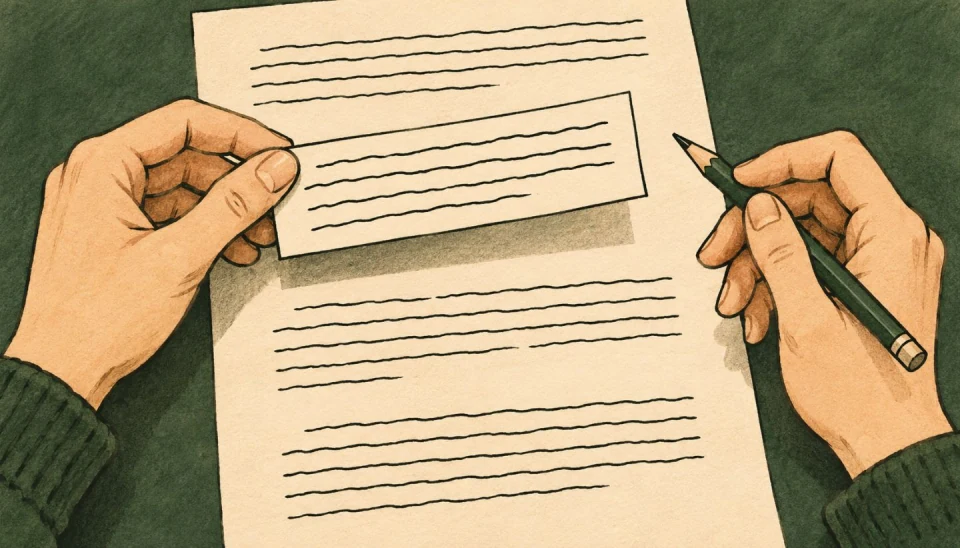
An attention-span statistic cannot tell you which information a reader can safely lose from a page. Before cutting a passage, establish the decision it helps someone make and what would happen without it.
That remains necessary when a reviewer cites an eight-second attention span. The figure may sound like a limit you should design around. It supplies no explanation of which paragraph is unnecessary, which qualification matters or what the reader came to find out.
My starting point would be the proposed deletion. I would ask for a reason tied to the passage and the reader's task. The source behind the statistic also needs checking, because the distinction between a repeated figure and a measured finding matters here.
What the Microsoft report contains
Microsoft Canada's Spring 2015 report, available in this public copy, does contain the figures. Page 6 shows 12 seconds for human attention in 2000, 8 seconds in 2013 and 9 seconds for a goldfish. It attributes them to Statistic Brain.
The report separately describes Canadian survey, game and EEG research. It does not establish the graphic's figures as findings from that work or provide a method behind the comparison. It would be inaccurate to say the report never mentions them. Their presence also cannot support treating 8 seconds as a measured universal limit.
This is enough to reject the report as authority for a specific reading limit. Further tracing might clarify the borrowed figures' provenance. It would still leave you needing evidence about what a reader needs from the page you are editing.
What reading research can tell you
In her 2020 account of NN/g's online reading research, Kate Moran describes an eyetracking programme spanning studies from 2006 to 2019. Scanning is prominent, while willingness to read depends on the task, motivation and other aspects of the reader's situation. Those observations do not set one time allowance for every page.
There is also a limit to what looking establishes. Kara Pernice's 2017 account of task-dependent scanning explains that attended information can still be misinterpreted or forgotten. A gaze plot alone cannot confirm that someone understood a condition or chose the correct next step.
Time on the page leaves similar questions open. A short visit could mean someone found the answer promptly. It could also mean they gave up. A longer visit could involve careful consideration or difficulty. You need more context to choose between those explanations.
The existing articles on content design and plain English cover the practical work of making a page easier to use. Here, the narrower issue is whether a general reading observation justifies a particular cut.
Review the proposed deletion
Start by describing what the passage contributes. A paragraph might explain an exception, supply evidence for a claim or tell someone what to prepare. It might repeat an answer already given. The reason for keeping or removing it should identify that contribution.
An eligibility exception illustrates the distinction. Suppose a page says most applicants can use a service, then explains a circumstance in which they cannot. Removing that explanation shortens the page. It also removes part of the basis on which someone decides whether to proceed. This is a hypothetical example, with no observed readers or outcomes.
The wording may still be poor. You could shorten the explanation, place the exception beside the main rule or separate detailed cases so readers can find the one that applies. Keeping the information does not require keeping its current expression.
Other passages may have no defensible job. A repeated introduction, a history unrelated to the task or several sentences restating the same claim are candidates for removal. I would expect the same scrutiny from someone defending the text as from someone proposing a cut. Complexity has to be explained at the point where it affects the decision.
When the disagreement concerns prominence, examine prominence. Necessary information can be buried under an introduction, given an unhelpful heading or placed after the point at which someone needs it. A request to reduce the word count can conceal a more specific problem that moving or rewriting the passage would address.
Check whether the revised page still works
Define what the intended reader should be able to do with the revised page. For an eligibility decision, that might mean recognising whether the exception applies and choosing the appropriate next step.
GOV.UK's moderated usability guidance, updated in October 2017, describes watching actual or likely users attempt relevant tasks without instructions that give away the answer. Applying that approach could reveal where a reader misses or misunderstands the condition. It would not, by itself, establish how often the problem occurs across the whole audience.
If you compare versions, keep the task and the relevant circumstances clear. A shorter time is useful only in relation to the result. Finishing quickly with the wrong understanding would leave the editorial problem unresolved.
You may need to decide before any reader research is available. Record that as a judgement. State what the passage is meant to do, why you chose its treatment and what uncertainty remains. The wider limits of using numbers to close editorial decisions are covered in what data cannot decide.
For the hypothetical eligibility paragraph, a proposed review note could read: 'Keep the exception beside the main rule. Remove the repeated introduction. Check whether a likely applicant can identify which rule applies.' Each change has a reason the next reviewer can examine.