The annotated journal
Resolving a conflict between brand voice and service clarity
Work through a disagreement about service wording: establish the meaning, examine alternatives and make any exception within the organisation's existing authority.
When a voice rule appears to make a service harder to understand, identify what the wording might cause someone to misunderstand. Establish what someone needs to know at that point, then examine whether the disputed wording supplies it accurately.
A writer's claim that a sentence is clearer needs scrutiny. So does a brand reviewer's claim that the approved voice requires the original. Both need to connect their preference to the reader's decision and the service's responsibilities.
I would try wording that satisfies both concerns before proposing an exception. If an exception is needed, its scope and the person authorised to approve it should be explicit.
Establish what the action means
Consider a hypothetical quotation form. This is an illustration, rather than an account of a client project or a user test.
Assume submitting the form asks the business to prepare a quote. It does not place an order or take a payment. The business has a conversational voice, with a rule encouraging expressive action labels.
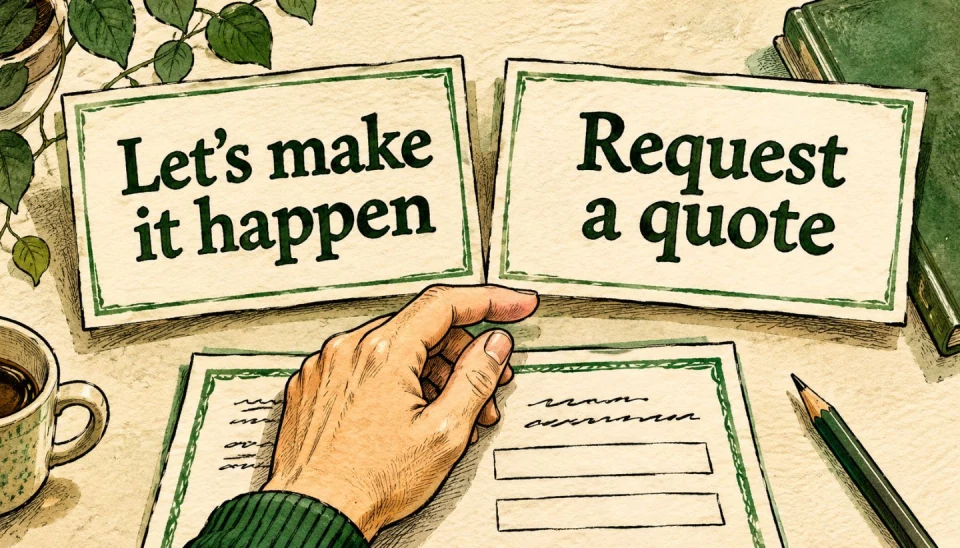
The disputed button says 'Let's make it happen'. A writer proposes 'Request a quote'. Both versions appear beside the same explanation: 'Sending this form requests a quote. It does not place an order.' The service facts and surrounding information stay the same in this comparison.
The expressive label might work in context. The writer has to explain what it risks obscuring. Perhaps the concern is whether someone will understand what submitting commits them to. That is a specific question the team can investigate. Calling the wording vague gives them less to work with.
The brand reviewer also needs to identify the concern behind retaining it. Consistent use of familiar language is a possible reason to examine. A general instruction to sound conversational leaves room to consider more than one expression.
Check the service facts before revising either version. If the team cannot agree whether submitting creates an order, a different button will not resolve the underlying uncertainty. Adding a promise about price or response time would also change the information. It should be checked as a service claim before anyone presents it as a voice improvement.
Check what the voice rule permits
A consistent voice can accommodate changes in tone. The NHS voice-and-tone guidance, updated in November 2019, describes tone changing with the situation and the reader's emotional state while preserving an identifiable voice.
There is a commercial example in Mailchimp's voice-and-tone guide. Its distinctive manner sits alongside an explicit priority for clarity over entertainment. That is Mailchimp's stated editorial choice. It gives no measured result for either label on the hypothetical form.
These examples are useful when a reviewer treats a voice rule as requiring the same manner everywhere. Check the actual rule. It may describe a general quality, such as being conversational, while leaving considerable choice in how to express it. An established product name or service term may allow less variation.
In the quotation example, 'Request a quote' describes the action. A more expressive phrase could appear in a heading or nearby explanation if it serves a purpose there. That is one option to consider alongside retaining the current label. The existing distinction between brand messaging and brand voice helps separate the service promise from its expression.
Investigate the disputed interpretation
Agree what the reader needs to understand before defending a version. For this form, the relevant distinction is between asking for a quote and placing an order.
John Waterworth's 2015 GDS account of testing words describes asking people to explain meaning and expected next actions. It offers a practical way to investigate an interpretation rather than rely on a claim that the words seem clear.
For the hypothetical form, I would want to hear what a likely customer thinks will happen after submission. Ask them to explain that in their own words before supplying the intended answer. Someone repeating the button label has given you less information than someone explaining the commitment they believe they are making.
Keep the task neutral. GOV.UK's moderated usability guidance, updated in October 2017, cautions against instructions that reveal the answer. Telling a participant to request a quote would provide the interpretation you are trying to investigate.
Observe the form in context, including the explanation beside the button. If someone misses that explanation, the issue may concern its placement or prominence. If the explanation itself is inaccurate, changing the tone is premature. Several possible problems can produce the same internal disagreement about a label.
A qualitative session can reveal a misunderstanding worth investigating. It cannot tell you how common that misunderstanding is across the whole audience. Changing several aspects together also makes it difficult to attribute any difference to the button's tone. Keep the observation and the interpretation separate in the review record.
Give the decision a defined scope
The person who may approve a change depends on the organisation's responsibilities. A style guide cannot assign that authority to a writer from outside the process.
Start by checking whether the writer already has authority to adapt the expression. Where the service claims stay the same and existing rules allow the change, the writer can make it within that authority. A preference for different wording does not itself create a reason to seek an exception.
If an actual rule prevents the proposed change, give its owner a bounded decision about this action. They may agree a local exception or decide the rule needs revision. Explain the service meaning that must remain accurate and the evidence or judgement supporting the proposed treatment.
If evidence is unavailable, record that limit. A provisional editorial choice can still be necessary. It should not acquire the status of a tested result because several reviewers agreed with it. General arrangements for owners and exceptions are covered in keeping brand messaging consistent across channels.
For the hypothetical quotation form, I would provisionally choose 'Request a quote'. It names the action under the service facts assumed here. That is an editorial judgement, with no user finding attached. The decision would be open to reconsideration if relevant reader evidence showed a problem with that label or supported retaining the original. Any record of the exception would apply to this action and its context, leaving other uses of the brand's voice to be considered on their own terms.